 Skip to Navigation
Skip to Content
Skip to Navigation
Skip to Content
Cut. Paste. Transform.
Juror's Statement
Since the nineteenth century, artists have cut, clipped, layered, and reassembled photographs and found materials to create collages. Over time, photo-collage has continually reinvented itself— from Victorian letters and works integrating photographs, to Cubist experiments that challenged traditional ways of seeing, to contemporary practices that deploy collage as a powerful social, political, cultural, and aesthetic tool.
Today, photo-collage thrives as an accessible and deeply resonant art form. Influenced by sustainability, nostalgia, archival research, digital manipulation, and community-based practices, collage bridges online creative communities while also appearing in major museums, galleries, publications, and art fairs. Artists such as Mickalene Thomas, Lorna Simpson, Colette Fu, Sohei Nishino, Wangechi Mutu, John Stezaker, Deborah Roberts, Lyle Ashton Harris, and Antonio Pulgarín demonstrate collage’s capacity to examine identity, history, and the construction of images themselves.
My first foray into mixed-media collage began a few years ago when, as a museum curator, I stopped a colleague from discarding a pile of old magazines and books. Although my studio practice at the time focused on photography and drawing, I immediately recognized the creative potential in those materials. I was also seeking a more sustainable and affordable art practice, and collage offered exactly that. Through social media, I found encouragement from an international collage community of groups that share work, organize exhibitions, and lead collective challenges such as Februllage, Paris Collage Collective, NY Collage Ensemble, and Edinburgh Collage Collective.
I conceived Cut. Paste. Transform. to acknowledge the ingenuity and vitality of contemporary collage artists. I was particularly interested in the growing number of photographers working in mixed media, and, as a curator, was eager to encounter new work that might inform future projects. I, therefore, encouraged submissions that pushed the boundaries of photography and collage in unexpected ways. The more than 1,000 submissions did not disappoint. Two consistent throughlines emerged: a strong emphasis on storytelling and an imaginative use, and reuse, of images. For collage artists, working with materials already laden with meaning presents a unique challenge, but the results can be remarkable.
During the jurying process, I was inspired by the range of materials and techniques that the artists employed. Submissions included analogue and digital collage, sculpture, assemblage, and installation using cyanotypes, gold leaf, hole punches, family photographs, Polaroids, magazines, drawings, letters, and even desk drawers. Numerous woven photographs and photographic constructions demonstrated how artists are pushing collage and photography into increasingly textural and three-dimensional realms.
Given the joy of discovery I experienced, narrowing the exhibition to just 75 works was extremely difficult, and I thank all of the artists who submitted work. Several criteria guided my selections. First, I sought to reflect the breadth of approaches represented in the submissions and within the broader collage community. Second, I prioritized originality and works that push the boundaries of photography and collage in ways that contribute meaningfully to the field. Third, I considered technical mastery and clarity of intention across diverse materials and processes. Finally, though more difficult to quantify, I considered each work’s potential to inspire viewers who may be unfamiliar with, or even skeptical of, photo-collage as an art form. In this way, I hoped to recreate for others the sense of possibility I felt when I first encountered that discarded pile of books and magazines and began my own journey into photo collage.
At its core, collage brings disparate materials together to create something new. The works in Cut. Paste. Transform. exemplify how the whole can become greater than the sum of its parts. From cutting and pasting comes transformation. In this sense, collage serves as both method and metaphor— illustrating what we, as artists and as people, can achieve, and transform, collectively.
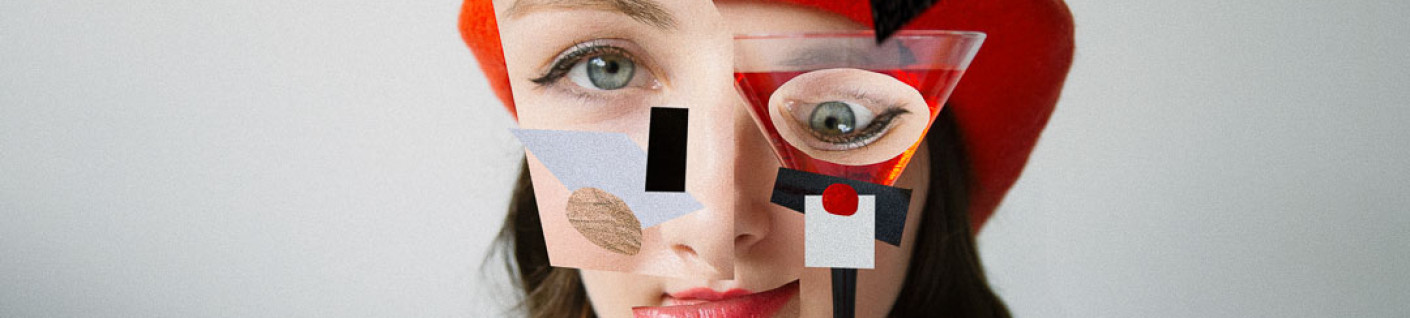
Banner Image: Natalia Forgacova
@natalia_forgacova
About the Juror
Francine Weiss, Ph.D. is an art advisor, independent curator, and artist based in Rhode Island. With more than 20 years of experience, she has held curatorial roles at the National Gallery of Art, Harvard Art Museums, deCordova Sculpture Park; Museum, Fitchburg Art Museum, and the Photographic Resource Center, where she also revitalized Loupe Journal, publishing three issues annually that featured leading contemporary photographers. From 2016–2024, she served as Director of Curatorial Affairs & Chief Curator at the Newport Art Museum, organizing exhibitions such as Social Fabric, Renee Cox: Revolution/Revelation, Annu Palakunnathu Matthew: ReVision, Hair Stories, The Shapes of Birds, and Andy Warhol: Big Shot.
Weiss has taught at Wellesley College, Simmons University, Boston University, and New England College’s MFA in photography program. She holds a Ph.D. in American art and the history of photography from Boston University and a B.A. in English from Wellesley College.
Her photography and mixed-media works have been exhibited at the Griffin Museum of Photography, Rhode Island Center for Photography, Danforth Art Museum, Overlap Gallery, Center for Fine Art Photography, Photosynthesis Gallery, Somerville Toy Camera Festival, and Espace Canopy in Paris.
Call for Entries
PhotoPlace Gallery invites submissions for CUT. PASTE. TRANSFORM., a juried exhibition celebrating photo-based collage in all its forms. From analog cut-and-paste to digital and hybrid practices, collage continues to challenge how images are constructed, layered, and reimagined.
We welcome work that explores identity, history, narrative, aesthetics, and social or political themes. Traditional or experimental, handmade or digital—if collage is central to your practice, we want to see it.
Today, photo-collage thrives as an accessible, versatile, and deeply resonant form. Sustained by movements in sustainability, nostalgia, archival practices, digital manipulation, and community connection, collage bridges online creative communities and appears in major museums, galleries, publications, and art fairs. Artists such as Mickalene Thomas, Lorna Simpson, Colette Fu, Sohei Nishino, Wangechi Mutu, John Stezaker, Deborah Roberts, Lyle Ashton Harris, and Antonio Pulgarín demonstrate the power of collage to explore identity, history, and the construction of images themselves.
We are honored to have Francine Weiss as juror for Cut. Paste. Transform. She will select up to 35 images for exhibition in our Middlebury, Vermont gallery and another 40 images for our Online Gallery. All 75 images will be reproduced in the exhibition catalog and remain permanently on our website, and be promoted on social media with links to photographer’s URL.
Submission Fee: $39 for 5 images, $6 for each additional image
Find more information about submitting your images here.
Click to enlarge